
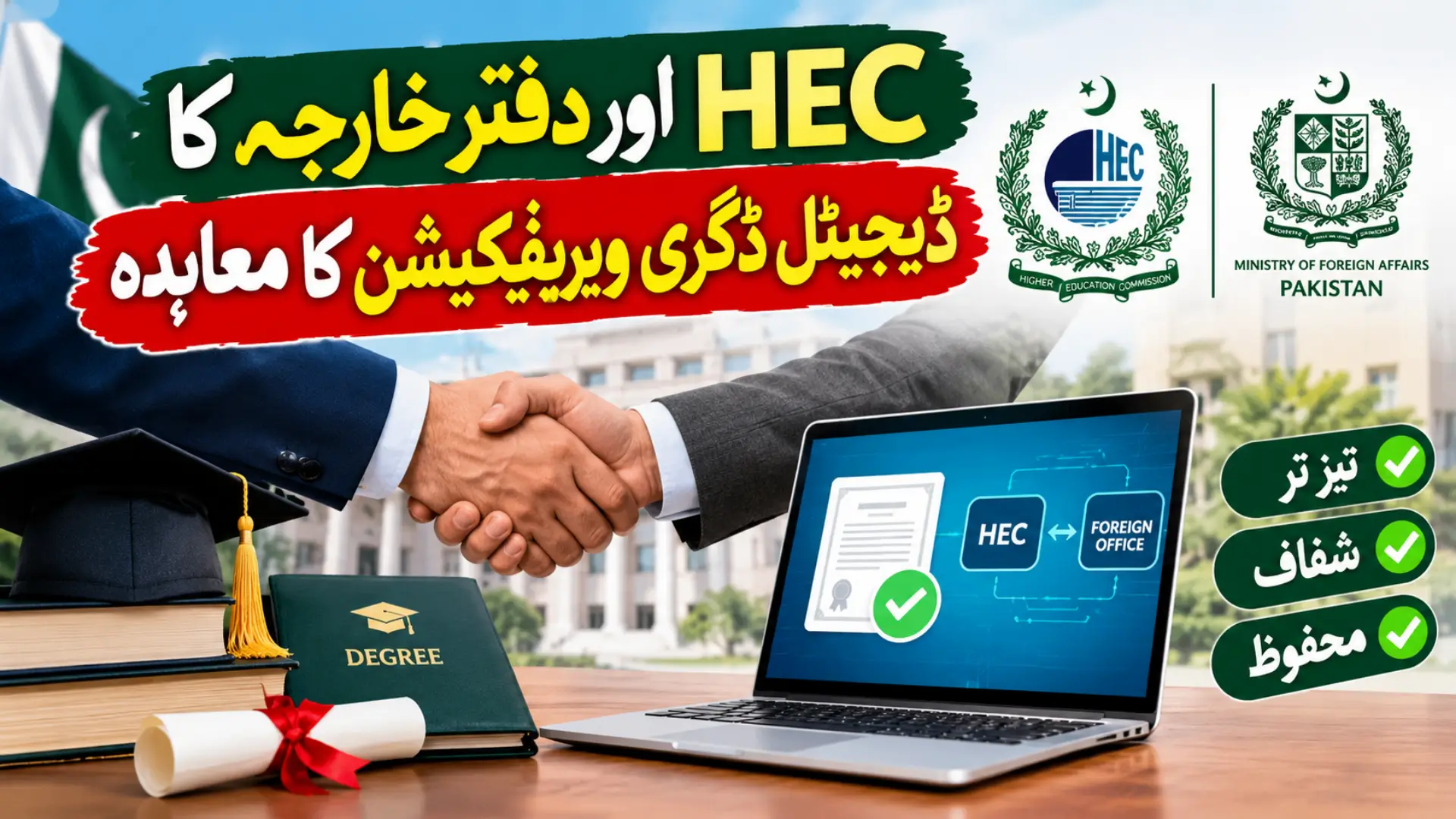
HEC Announces Digital Degree Verification Partnership With Foreign Ministry
HEC Announces Digital Degree Verification
HEC Announces Digital Degree Verification Higher Education Commission (HEC) and Pakistan’s Ministry of Foreign Affairs have signed a Memorandum of Understanding (MoU) to establish a secure digital system for verifying academic credentials. The agreement aims to connect the two institutions through API-based integration, allowing direct verification of degrees and other credentials attested by HEC.
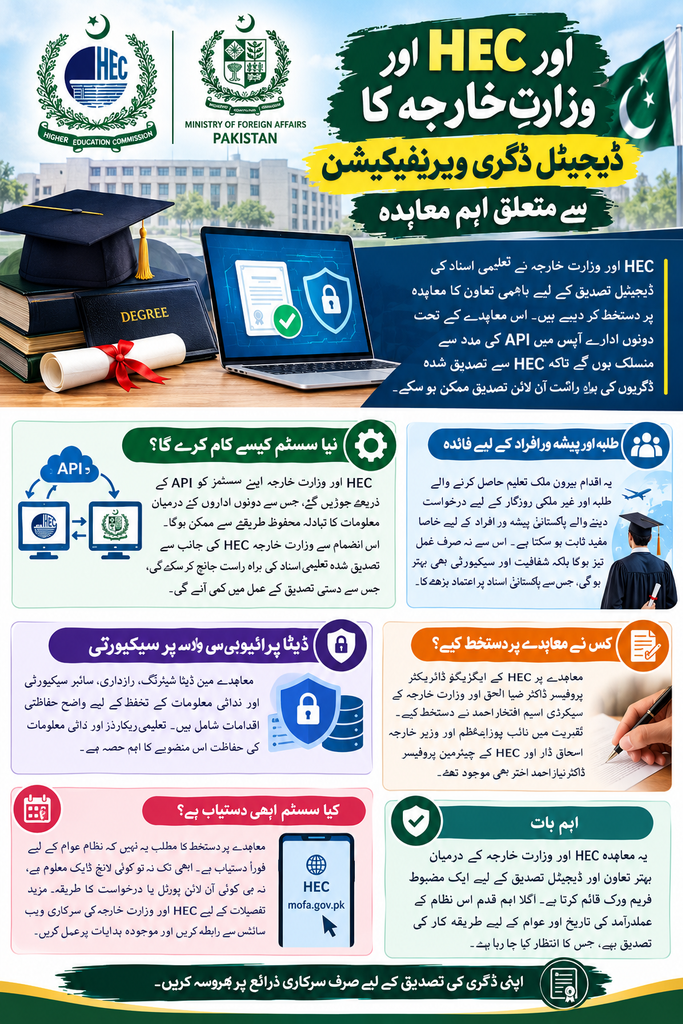
The initiative is intended to make the verification process more efficient, transparent, and secure, particularly for Pakistani students and professionals who need their academic documents verified for use abroad. However, the announcement does not yet confirm a public launch date or a new online portal for applicants.
You Can Also Read: Fully Funded Scholarships 2026 for Pakistani Students
How the HEC Digital Degree Verification System Will Work
Under the agreement, HEC and the Ministry of Foreign Affairs plan to connect their respective attestation systems through an application programming interface (API). In simple terms, this technology allows separate computer systems to exchange information securely.
This integration is intended to help the Foreign Ministry verify HEC-attested academic credentials directly, reducing reliance on manual verification processes. It could also help improve the reliability of credential checks by enabling the two institutions to exchange verification information electronically.
The agreement focuses on institutional integration. Details about how individuals will access the system, whether they will need to submit additional documents, and when the arrangement will become operational have not been confirmed in the information provided.
You Can Also Read: Punjab Announces Ban on Several Items
What the New Agreement Means for Pakistani Students and Professionals
The initiative could be particularly useful for Pakistanis who need their academic qualifications verified for international purposes. Students pursuing opportunities abroad and professionals applying for overseas employment may benefit from a more streamlined process between the two government institutions.
According to the announcement, the project aims to improve efficiency and transparency while making verification more resistant to tampering. Strengthening the verification process could also help build confidence in Pakistani academic credentials among relevant foreign institutions and employers.
However, the agreement does not guarantee automatic acceptance of Pakistani degrees by foreign universities, employers, or other authorities. Applicants should continue to follow the document requirements of the institution or country where they intend to use their qualifications.
You Can Also Read: ICT Police Hajj and Umrah Welfare Scheme 2026
Data Privacy and Cybersecurity Safeguards
Secure information sharing is a central part of the HEC–Foreign Ministry agreement. The MoU includes safeguards relating to data sharing, confidentiality, cybersecurity, and the protection of personally identifiable information.
These measures are important because academic verification may involve personal details and sensitive educational records. Secure digital communication between the institutions is intended to support verification while protecting the information being exchanged.
The announcement does not specify the technical security standards, data retention arrangements, or detailed privacy procedures that will be used. Further information about these measures may become available through official announcements as implementation progresses.
Who Signed the HEC and Foreign Ministry Agreement?
The MoU was signed by HEC Executive Director Prof. Dr. Zia Ul Haq and Foreign Secretary Asim Iftikhar Ahmad. Deputy Prime Minister and Foreign Minister Mohammad Ishaq Dar and HEC Chairman Prof. Dr. Niaz Ahmad Akhtar witnessed the signing ceremony.
Senior representatives from both organisations were also present. The agreement establishes a framework for cooperation between Pakistan’s higher education authority and its foreign affairs ministry to improve the digital verification of HEC-attested academic credentials.
Is the Digital Degree Verification System Available Now?
The signing of the MoU confirms the agreement between the two institutions, but it does not by itself establish that the digital verification system is already available to the public.
The supplied announcement does not confirm a launch date, a dedicated public portal, an application procedure, processing fees, or changes to the existing attestation process. People who need their degrees verified should therefore avoid assuming that they can immediately use a new service.
For the latest information, applicants should consult the official websites of the Higher Education Commission and the Ministry of Foreign Affairs. They should follow the currently published instructions until either institution announces a change to its procedures.
Conclusion
The HEC and Foreign Ministry’s digital degree verification partnership aims to make the verification of HEC-attested academic credentials more secure and efficient through direct digital integration. The initiative could benefit Pakistani students and professionals who need their qualifications verified for international purposes.
The next important development will be confirmation of the system’s implementation date and the procedure individuals will need to follow. Until then, applicants should rely on official HEC and Foreign Ministry guidance rather than assume that a new public verification service is operational.
Frequently Asked Questions
1. What is the HEC digital degree verification partnership?
It is an agreement between HEC and the Ministry of Foreign Affairs to establish secure, API-based integration between their attestation systems for direct verification of HEC-attested credentials.
2. Will the new system allow online degree verification?
The agreement aims to enable digital verification between the two institutions. However, the announcement does not confirm whether a separate public-facing online portal will be introduced.
3. Who may benefit from the digital verification initiative?
Pakistani students, graduates, and professionals who need their HEC-attested academic credentials verified for international purposes could benefit from a more efficient verification arrangement.
4. Has HEC announced a launch date for the system?
No launch date is specified in the information provided. Readers should check official HEC and Foreign Ministry announcements for implementation updates.
5. Will the new system guarantee acceptance of Pakistani degrees abroad?
No. The initiative aims to strengthen credential verification, but foreign universities, employers, and authorities may have their own recognition and documentation requirements.




2 Comments